Lift the cushion.
Play the keys.
Model M starts with the Akai LPK25 Mk2 donor and a 355 mm body, with its 25-key MIDI keybed revealed. Nektar SE25 remains available as a comparison. The soft gray palm-rest carrier can cover the music bay for typing, within the same fixed surround. Eggshell remains the default. Explore 28 coordinated palettes, including Alaya Black, with varied typing-key colors and catalog TPU wrist-rest colors in the finish collection. A small wooden modulation wheel sits on each side, with removable side cheeks for access. The latest component-fit studies are linked below.
Explore Model M in 3D ↗Compare Model DModel D shares M’s closed exterior dimensions, screen, wraparound grilles and everyday audio controls, with a fixed palm-rest deck in place of the music bay, wooden music wheels and removable cover.
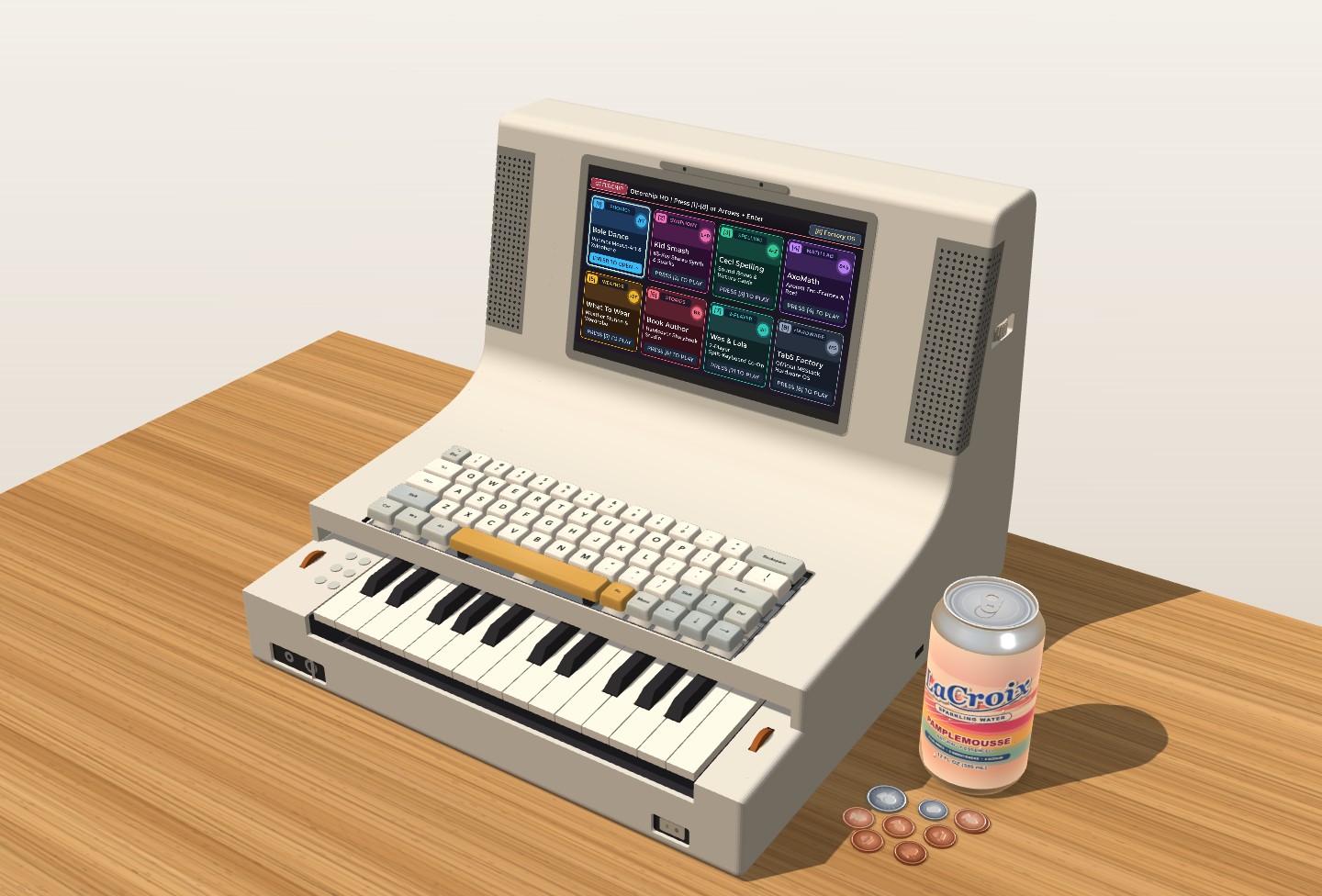
Fixed body, removable cover. The screen, typing keyboard, MIDI keybed and outer rigid surround stay in place. The cushion carrier and removable side cheeks provide access to the music bay. The design has no adjustable screen joint or sliding keybed. This is an appearance and packaging study, not fabrication CAD or a tested hardware assembly.
A familiar palm rest.
The gray cushion sits in a rigid removable carrier. The carrier seats against the body so palm pressure is supported by the enclosure, with clearance above the music keys.
The keys stay ready.
Removing the carrier exposes the key fronts close to the body edge, leaving roughly one carrier thickness of shell material ahead of them. The rear mechanism tucks under the typing deck; its dimensions and travel still need measurement.
Component evidence, not guessed packaging.
The Build & fit panel defaults to Akai LPK25 Mk2 in a 355 mm body. This study uses its photo-derived sprung keybed and a separate controller-board reservation. Nektar SE25 at 388 mm remains a comparison with its photographed key and six-button positions. Its earlier 355 mm compact concept remains explicitly unverified.
Both layouts keep the screen center at 221 mm, its 10.5° lean, the 300 × 41 mm cushion and the chosen colors. D follows the same exterior dimensions with a fixed palm-rest deck. A taller deck changes the table/chair setup needed for comfortable typing: check it with a physical mockup before committing to a print.
LPK25 Mk2 · default donor
Photo-derived sprung keybed, controller-board relocation and a fitted backing tray for the 355 mm study. Frame dimensions, screw positions and the ribbon route still require an opened donor.
Open measurements and 3D viewer ↗SE25 reconstruction · comparison
Five product views, underside observations, camera-matched renders, silhouette differences and held-out reference features. Download the complete-product and uncased-envelope models.
Open measurements and 3D viewer ↗The visible layout is reconstructed from photos. The hidden chassis, boards, pivots, travel and screw threads remain unmeasured. The published 335 × 100 × 21 mm specification does not settle the internal fit.
Typing keyboard reconstruction
A full 19.05 mm grid replaces the smaller appearance keyboard. Compare YMDK DK61-64 and GK64x candidates, keycap profiles, a 285 × 94.6 mm PCB envelope, and a removable backing bed.
Open CAD and photo comparisons ↗The GH60 reference has open CAD; the commercial candidates are checked against photographs. Their precise revision, plate and mounting locations still need confirmation.
The typing support reserves 16.6 mm below the deck. The MIDI drop is constrained to leave 3 mm beneath that support. A separate adjustable donor-underside reserve and travel allowance keep uncertainty visible; they are not measurements of an opened donor.
A place for the removable cover.
Enable the rear storage dock, then choose Park at rear. The same cover turns 180° about the vertical axis, keeping the cushion facing up. Its rigid carrier meets the top and rear surfaces; the soft cushion remains raised. The rear body grows only enough to fit the storage recess and its supports.
Try the optional presence-sensor preview: the display stays dark until the cover is parked. A protected DRV5032 Hall switch and captive magnet are candidates; sensing distance, magnet retention and the firmware circuit remain prototype work.
See the parked cover ↗Make room for the complete controls.
Build & fit lets you compare sourced 3.5 mm headset sockets, Neutrik 6.35 mm jacks, recessed rockers, volume encoders and wooden-wheel sensors. The internal view includes connector bodies, terminals, bearings, shafts and brackets at full size. Changing a sensor cannot make the supporting mechanism disappear.
The wooden wheels and 50 mm volume cap are custom parts around available bearings and sensors. The small wood discs need supported hubs; they are not off-the-shelf complete controls. Component drawings, ordering links, availability limits and electrical notes are in the parts report.
Open parts catalog and structural study ↗Stiff supports that can still come apart.
Compare lightweight, balanced and stiff support concepts. Removable crossbars, replaceable drill pads and backing plates give the donor parts support while leaving assembly access. Drill the sacrificial supports after measuring the hardware; do not use a photo-estimated hole as permission to drill a circuit board.
The study uses ribs and cable windows instead of uniformly thick solid walls. Mass estimates are geometric PA12 estimates before electronics and ballast, not printing quotes. The frame study also examines a separate load-spreading lid and full-width foot support.
No sitting-load claim has been established. The exposed keys and display need a protected load path, and tip resistance depends on the assembled mass and center of gravity. The report records load cases, simplified calculations, uncertainty and the physical tests still needed.
Warm wood at the fingertips.
Grille controls include face width, side wrap, height, vertical offset, corner radius, hole spacing, hole diameter and solid border. Square corners and display-height alignment remain the starting shape. Editing any parameter preserves your camera position.
The instrument deck opens through the front across the piano keys, so no upper plastic strip crosses their ends. Fixed front walls close the areas beneath the function pads and modulation wheels. The removable carrier meets those raised side walls, while the headphone and power controls stay in the lower front fascia. Final key travel and finger clearance still require the measured donor mechanism.
Two small wooden modulation wheels flank the keybed. Each starts at 28 mm diameter × 4 mm thickness, with a 4.5 mm arc exposed above its seat. Their fore/aft setting starts at 7 mm; position and size remain adjustable in the study. The wheels, shafts, sensors and stops need a custom assembly, with clearance under the seated cushion carrier.
The warm material draws on Nord’s wooden Pitch Stick and the tactile performance controls of the Nord Modular G2. M uses a matching wooden wheel on each side; their MIDI assignments can be chosen in firmware.
Shape the rear as one continuous surface.
The rear-profile controls set a 0–20% forward slope and a 0–50% vertical starting height. A 20% slope means 20 mm of forward displacement per 100 mm of vertical rise, rather than a 20-degree angle. The wall blends smoothly into the sloped portion above the chosen height. The starting slope is 10%, beginning at 20% of the body height; changing these parameters selects a new fixed enclosure shape.
Give stereo sound room inside the body.
Reserve two independent sealed speaker chambers in the substantial rear volume. Thin vertical grille pieces flank the screen and wrap into the sides, keeping the music bay available at the front. The driver orientation and acoustic path are being explored inside that fixed exterior.
Speaker candidate
Two Dayton Audio ND65-4 full-range drivers: each has a 64 mm frame, 48 mm depth and 52 mm baffle cutout. Budget roughly $50–64 for the pair, depending on seller.
Reserve approximately 1.4 liters of net sealed volume per channel, following the manufacturer’s enclosure starting point. The sloped rear changes the geometric chamber space and driver clearance. These are gross reservations, not achieved net volumes: driver displacement, ribs and wiring reduce them. Check the current cutaway and actual parts together before freezing the enclosure. Chamber depth, driver placement and final response need a physical redesign and listening test.
Stereo amplifier candidate
The Adafruit dual-MAX98357A board provides separate left and right channels from digital I²S audio for $9.95. It is only 25.5 × 19 × 11.8 mm and can use a 5 V supply.
It is a practical first amplifier for either host. Its advertised 3.2 W per channel is specified at 10% distortion; choose the operating level from clean-output measurements and listening tests.
The default grille pieces sit flush beside the display, match its top and bottom exactly, and wrap a short distance around the body sides. Height, vertical offset and corner radius can be tuned while preserving the flush fit. The current preset uses a 33 mm front band and a 15 mm side return. Their outer surfaces are taken from the shell mesh so the inset follows the same corner curvature. The 64 mm drivers cannot fit directly front-facing beside the complete panel module; the cutaway instead shows provisional side-facing envelopes. Speaker mounting and the acoustic path to the grilles still require a physical fit and listening test.
Use gasketed driver mounts, stiff chamber walls and sealed cable passages. Keep speaker air pressure out of the microphone compartment. The MIDI cover also needs positive seating so it stays quiet when bass notes play.
One microphone system, two recording modes.
The input must capture both clear speech and natural music. Preserve a full-band recording path first, then apply speech processing as a selectable mode. A microphone designed only for voice commands would limit the music side of M.
Keep the performance.
Target 48 kHz recording with speech noise suppression, automatic gain changes and echo cancellation bypassed. Preserve the original recording for singing, instruments and everyday sounds. Set gain with headroom and offer headphone monitoring when recording along with playback.
Make words easier to hear.
Use a separate processed stream for reading aloud and conversation. Echo cancellation needs a synchronized reference to the sound actually sent to the speakers. Stereo playback requires the chosen processing to handle both channels correctly.
A promising microphone component is the Infineon IM72D128: a digital PDM microphone with 72 dBA signal-to-noise ratio and 20 Hz low-frequency roll-off. Its flex evaluation boards can help place capsules in a replaceable carrier above the screen. This is a component candidate, not a complete plug-in audio interface.
Reserve short, individually sealed acoustic paths from the microphone ports to the outside, with mechanical isolation from typing and speaker vibration. Keep the carrier serviceable while capsule spacing, grille geometry and acoustic response are tested.
Check the processing, not just the USB sample rate. The XVF3800 voice pipeline used in common ReSpeaker boards processes speech at 16 kHz and uses a mono echo reference. A 48 kHz transport setting does not turn that processed stream into a full-band music recording, or establish true stereo echo cancellation.
Choose the host with the whole audio path connected.
Keep the firmware appliance.
A Waveshare P4 board and supported 10.1″ panel remain a candidate. Before freezing the circuit, check available GPIO, microphone PDM capture, stereo I²S output, clocks and simultaneous display/audio operation.
The MIDI controller also needs USB MIDI host integration. Verify the typing keyboard and MIDI device together, including any hub and USB power requirements. Sharing a USB connector type does not establish firmware support.
More room for music software.
A Pi 4 offers a broader USB audio and MIDI software path, plus more headroom for instruments, recording and effects. It is the easier integration direction to evaluate for a richer music application.
Linux can keep natural capture separate from a processed speech stream; PipeWire’s echo-cancel module describes the capture, playback and reference routing. Latency, stereo cancellation and the exact audio interface still need a bench test. The PDM microphone candidate needs an interface here too.
Controls that belong to the fixed body.
Two recessed headphone sockets sit at the front left, below the MIDI key bed: a 3.5 mm CTIA headset socket for stereo headphones with an analog microphone, and a 6.35 mm stereo TRS socket. CTIA assigns the four contacts to left, right, ground and microphone. The larger socket accommodates larger headphone plugs; amplifier performance determines the sound quality.
The compact layout keeps the front edge close to the keys, with no added front service extension. The front controls start 47 mm in from each side, 17.5 mm above the tabletop, with a 2.5 mm recess. Connector bodies and wiring now have to be packaged alongside or beneath the provisional uncased keybed. The Neutrik NMJ6HCD2 drawing gives a 23.53 × 18.2 × 15.67 mm body, plus 4 mm PCB pins. The study retains a 35 mm connector-and-wiring reservation; clearance to the actual bare keybed is unknown. Connector choice, orientation and mounting may need to change after measurement.
A separate volume wheel.
A gray 50 mm horizontal volume thumbwheel sits in the right side, separate from the two wooden keybed wheels. It starts at the screen’s 221 mm height and halfway through the upper body’s local depth. Its axle runs vertically. Only about 1 mm of rim projects beyond the shell, with a 4 mm finger recess for access to the grip.
A Bourns PEC11L encoder is a candidate behind the wheel. An independently supported shaft carries finger loads. The model exposes position, diameter, thickness and recess adjustments.
A small recessed power rocker.
The front-right control mirrors the headphone recess and stays attached when the cushion carrier is removed. Its compact envelope follows the C&K 7000 J1 PCB-mount rocker, whose actuator footprint is 16.87 × 9.27 mm. Final mounting and operating clearance remain provisional.
For a Pi build, this switch should request graceful shutdown through a power controller, then disconnect device power. The recessed rocker is a low-voltage control, not a mains switch.
Plug detection should mute the speakers. The proposed control logic detects either socket, disables the speaker amplifier and routes playback through a proper stereo headphone codec or amplifier. The MAX98357A speaker outputs are bridge-tied; they must not be connected to common-ground headphone sockets. The headset microphone needs its own biased analog input, separate from the natural-recording microphones.
The Waveshare WM8960 Audio Board, SKU 15019, is a possible bench starting point for headphone output and headset-microphone capture. Wiring, CTIA connection, host drivers, detection and high-impedance headphone headroom need verification. The similarly named Audio HAT does not expose a headset-mic input, and Pi 4’s onboard four-contact socket carries audio and composite video rather than microphone input.
These are component envelopes and proposed audio behavior. The interactive study changes geometry; no plug detection, audio routing or power hardware has been implemented or tested.
What the physical prototype needs to settle.
- Measure and play the controller. Measure the uncased LPK25 Mk2 keybed, contact boards, mounting points, full key travel and cable exits. Check the separate controller-board reservation, ribbon route and wooden wheel assemblies together.
- Print the front bay and cushion carrier first. Test the fixed front surround, removable side cheeks, palm-load support, cover clearance and key access. Check the headphone reservations against real parts before printing the complete body.
- Listen and record in representative chambers. Check stereo separation, case vibration, microphone noise and natural recordings, then tune the speech-processing path.
- Run display, typing, MIDI and audio together. Validate power, USB enumeration, recording stability and playing latency on the chosen host before producing manufacturing CAD.