A little lower.
A little more room.
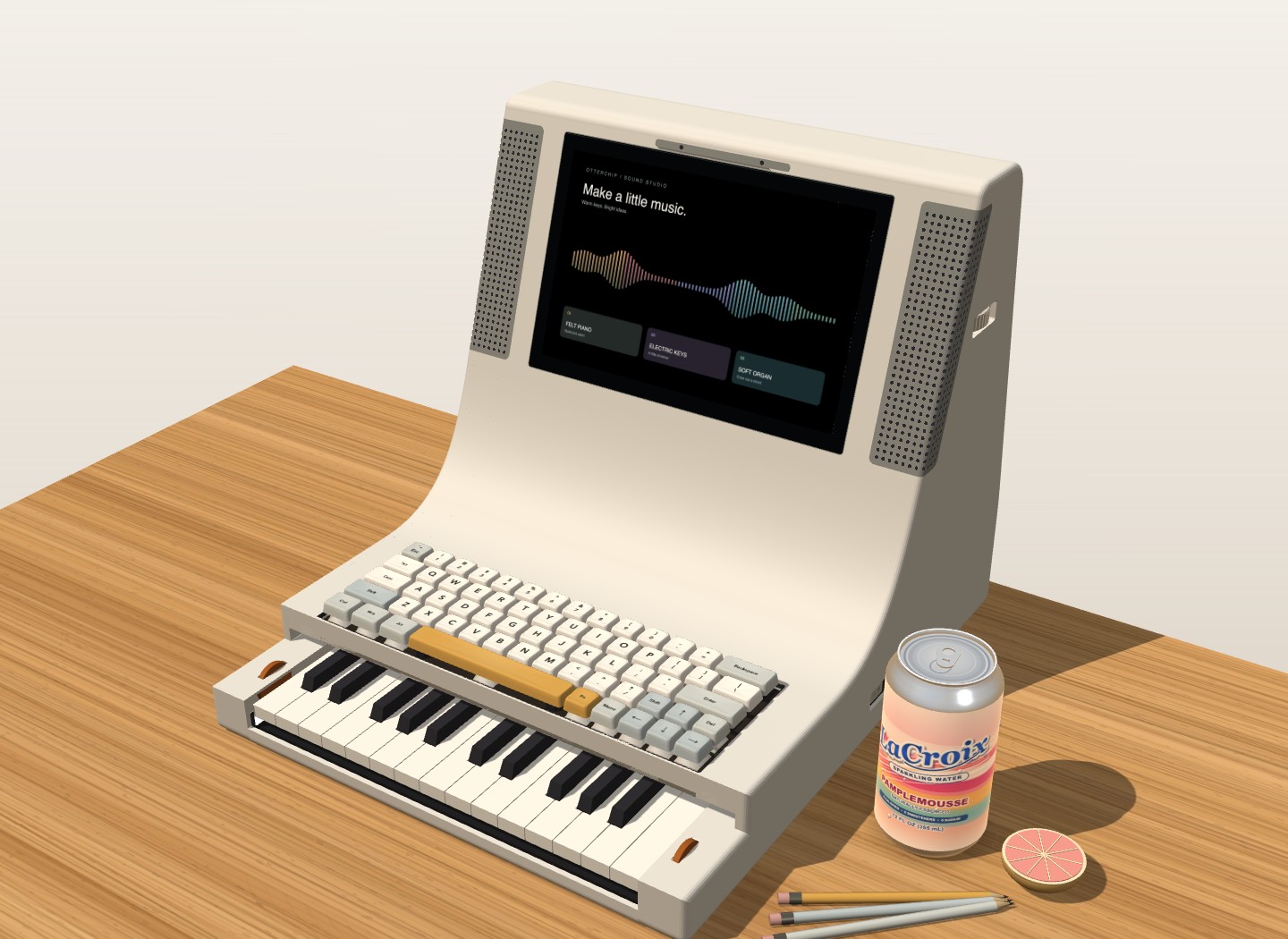
Model E brings the keys closer to the table and lifts the screen into a gentler line of sight across childhood. It keeps M’s 355 mm width, flowing shell, stereo grilles and removable music cover. The body is fixed; the furniture changes to fit the person.
E is the home-page default. The small graph button compares published M, D, E, X and W designs; typing and music have separate curves. The person button and age wheel inspect the current design without resetting your camera.
Lower hands, quieter shape.
A 28.5 mm lower deck and a lower 7 mm palm cushion reduce the height between the table and typing keys. Moving the jacks to the left side and the power rocker to the right removes their former stack underneath the music keyboard.
The shallow front stays visually light. The continuous body rises into the display; the grille corners soften slightly, and both grilles keep the display’s outer top and bottom alignment.
A deliberate compromise.
A farther screen narrowed the viewing-angle differences between younger and older children. The selected design is about 33 mm deeper than M. The best sampled candidate was another 67 mm deeper; E keeps approximately 87% of its improvement under the study’s objective.
Typing scores improve at every nominal age from 3–12. Music-only scores are slightly worse at ages 3–7, particularly age 3, because the higher screen favors typing and older children. Both results remain visible.
The dimensions behind the change.
| Published geometry | Model M / D | Model E |
|---|---|---|
| Body width / depth | 355 / 382.2 mm | 355 / 415.4 mm |
| Deck height / slope | 91 mm / 4° | 62.5 mm / 0° |
| Typing key top, above table | 101.8 mm | 73.3 mm |
| Music target, above table | 56.2 mm (M only) | 31.0 mm |
| Screen center / lean / setback | 221 mm / 10.5° / 159 mm | 245 mm / 18° / 180 mm |
| Cushion rise / typing gap | 11 / 14.5 mm | 7 / 10 mm |
| Display and donors | 10.5″ 2560 × 1600 AMOLED; LPK25 Mk2 music donor. E targets a GK64X assembly with DSA typing keycaps. | |
These are the published baselines. Saved URL parameters can display another geometry. Screen setback is the horizontal offset from the typing-keyboard center to the screen center, not eye-to-screen distance.
Compare the measurements, not just a score.
The graph button offers wrist bend, forearm slope, elbow angle, shoulder-to-wrist distance, viewing angle and distance, plus suggested table and chair heights. M and D have the same typing geometry; only M and E have music curves. Selecting a graph age also updates the visible person.
The numerical search weights typing 70% and music 30%, and gives ages 3–12 equal weight. It balances viewing, elbow, wrist and reach terms, then checks ±8% stature sensitivity and the worst nominal age. E’s combined design loss is 0.01480, compared with 0.05235 for M. This is a transparent design preference, not a health score or a promise of individual comfort.
Estimated body proportions, a 26 mm tabletop, supported feet and automatically fitted furniture are shared across designs. Actual stature can be entered in Body fit & ages; individual limb proportions, hand span, playing technique and comfort still need observation.
Engineering files for the first physical build.
The CAD has an E-specific 3 mm aluminum keybed backing tray, distributed floor supports, lower wooden-wheel cradles, side control plates and revised service access. It retains practical drill-to-fit donor mounting areas. Rigid shell modules and the flexible wrist pad are separated by material.
Build instructions, parts and release checks ↗
First-prototype release, not production qualification. Digital interference, fastener, service-access and mesh checks are included. Real donor fit and key travel, pad retention, electrical operation, acoustic performance, heat, stability and load capacity still require a built unit. Do not treat the enclosure as a seat until a defined physical load test establishes that use.
The optional top-rear cover storage shown in the interactive study remains a visual concept and is excluded from this E manufacturing package. Changing viewer sliders does not regenerate the frozen downloadable CAD.