Typing first.
Music on the next tier.
X changes the layout: the typing keyboard sits low at the front, and the piano keys sit behind it on a raised tier. A farther screen reduces the spread of viewing angles across childhood. The palm cushion stays in place; a separate lift-off lid can cover the music keys.
E is the site default. X is a new geometry study with provisional component dimensions; E’s fabrication files do not fit X.
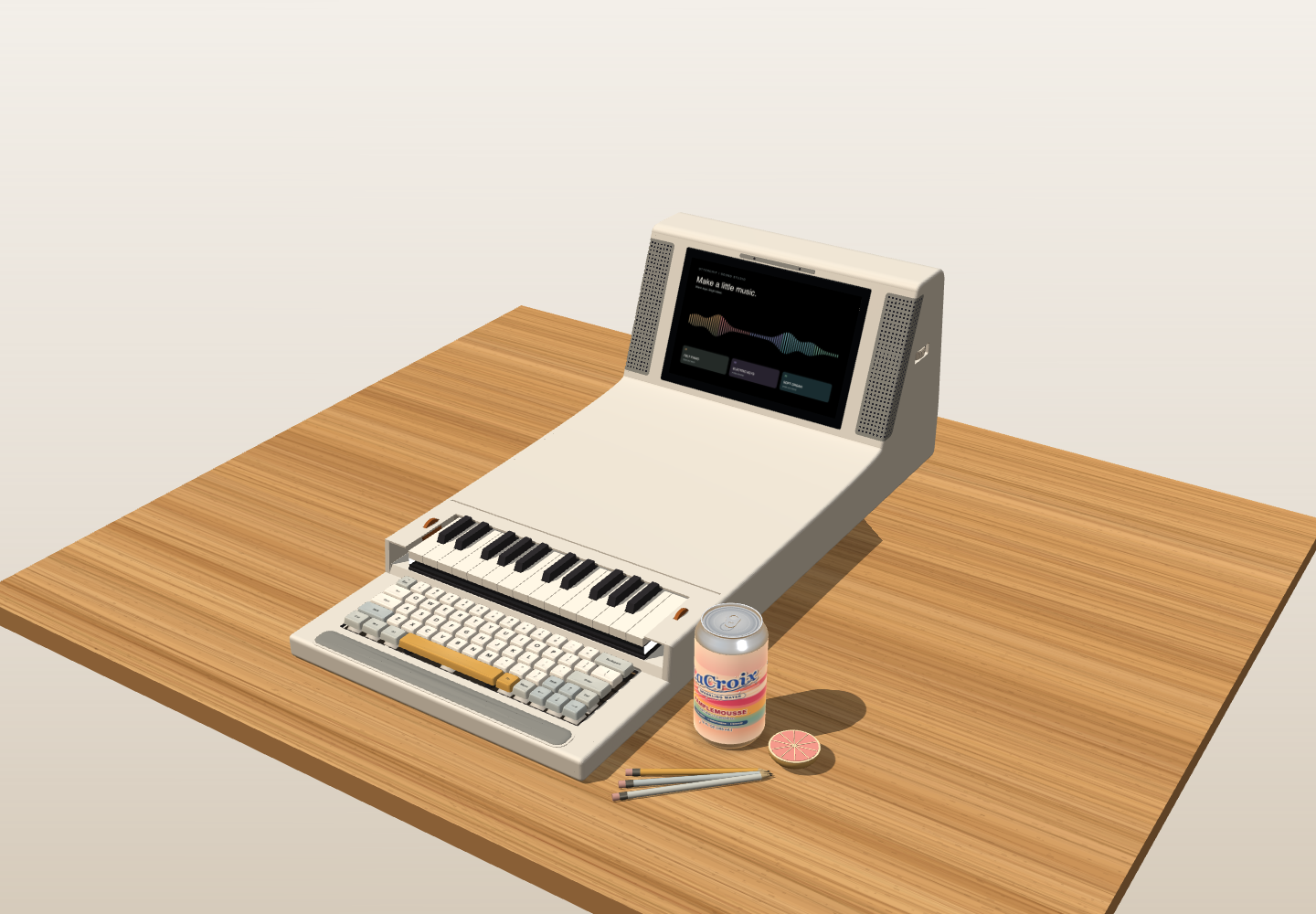
What constrained Model E?
E was intentionally compact. Its search varied screen height from 190–300 mm and lean from 5–35°; the chosen 245 mm and 18° did not hit those limits. Screen setback was limited to 130–250 mm, and the best sampled result reached 250 mm. The published E instead chose 180 mm to keep the body about 415 mm deep instead of about 482 mm.
The original layout also kept the typing keyboard above the music mechanism, a fixed donor stack, a 28 mm wooden-wheel mechanism, a 41 mm palm cushion and nonnegative keyboard slopes. Its 62.5 mm minimum deck height was set by the wheel mechanism plus floor clearance. A 35 mm minimum rise into the screen surround was another styling rule.
X explored wider screen ranges, negative and positive deck slopes, palm-support geometry, wheel sizes and a different keyboard layout. Its selected manuals are level because the separate tiers already lower the typing keys substantially. See the complete constraints audit.
The measurable tradeoff.
| Published geometry / modeled measurement | E | X |
|---|---|---|
| Body width × depth × height | 355 × 415 × 338 mm | 355 × 739 × 253 mm |
| Keyboard layout | Typing above front music bed | Low typing front; raised music behind |
| Typing key tops | 73.3 mm | 37.3 mm |
| White music keys | 31 mm | 60 mm |
| Screen center / lean / setback | 245 mm / 18° / 180 mm | 162 mm / 21° / 526 mm |
| Front palm support | Lift-off cover over music bed | Permanent shallow palm cushion |
| Maximum typing upper-arm lift | 34.2° | 11.4° |
| Maximum music upper-arm lift | 7.1° | 24.3° |
| Weighted design loss | 0.01480 | 0.00352 |
Upper-arm maxima cover both activities separately across ages 3–12 and nominal stature ±8%. These are estimated bodies, not measured percentiles or clinical thresholds. Values refer to the published layouts.
X lowers the original weighted design loss by about 76% versus E. That is a change in a designer-chosen mathematical score, not a percentage improvement in human health or comfort. The low front keyboard reduces modeled typing shoulder lift. Music reaches farther back and requires more upper-arm lift than E; this is the explicit tradeoff under the 70/30 priority.
The original score slightly preferred a revised stacked layout over this arrangement. We chose the separated tiers because relaxed typing arms and lower key height matter beyond what that score measures. The graph button includes upper-arm lift and key height, so these differences remain visible.
A farther screen needs larger text.
The modeled eye-to-screen range is approximately 65–91 cm. With the same 10.5″ panel, text needs to be about 1.35–1.84× larger than on E to preserve its angular size. This follows from viewing geometry; it is not a recommended pediatric distance range.
The old objective has a broad zero-penalty distance band, so it cannot establish readability. X is about 74 cm deep, compared with E’s 42 cm. The extra desk depth and larger required UI text are real costs. E remains the more compact default. OSHA’s adult workstation guidance also emphasizes readable text at a comfortable distance, and Cornell’s child guidance emphasizes balanced head position, relaxed arms and fitting the workstation to the child.
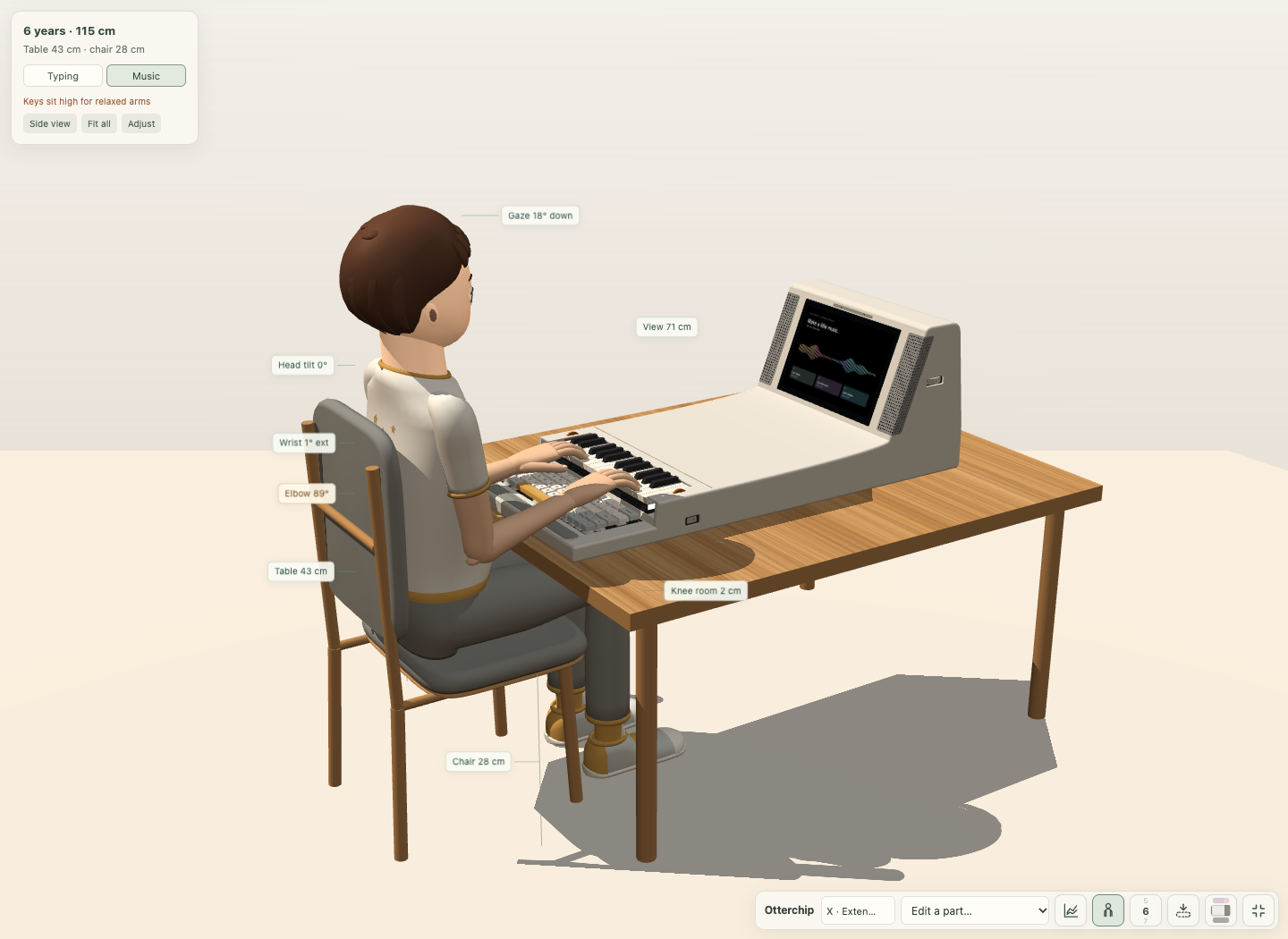
One chair and table for both keyboards.
The standard graphs retain the same automatic-furniture policy used for E. We also tested X and E with one table and chair setting per reference child, shared between typing and music. X’s loss becomes 0.00368; E’s becomes 0.01513. Neither layout receives an invisible furniture adjustment in that additional check.
The 60 age/activity/stature cases pass the study’s hard geometric gates. Soft posture warnings remain, including raised hands; the study does not claim perfect posture. A separate rear black-key probe reaches a maximum modeled upper-arm lift of 31.5°, illustrating the remaining music reach cost.
Buildable geometry, with fitting work still ahead.
The two full-size donor assemblies occupy separate footprints with a 5 mm gap. The typing assembly has 9.9 mm of space beneath it, and the music donor has 39.5 mm. The white-key front has a modeled 5.7 mm residual over the typing caps after reserving 8 mm key travel and a 9 mm finger envelope.
A practical build needs separate supported mounting beds, drillable backing plates, a ribbed or rail-supported long base, and access to the relocated controller PCB. Donor dimensions, moving-finger clearance, screen mounting, stability and structural stiffness still require measurement and physical prototypes. This release does not include a new production-ready X print set.
Clearer measurement callouts.
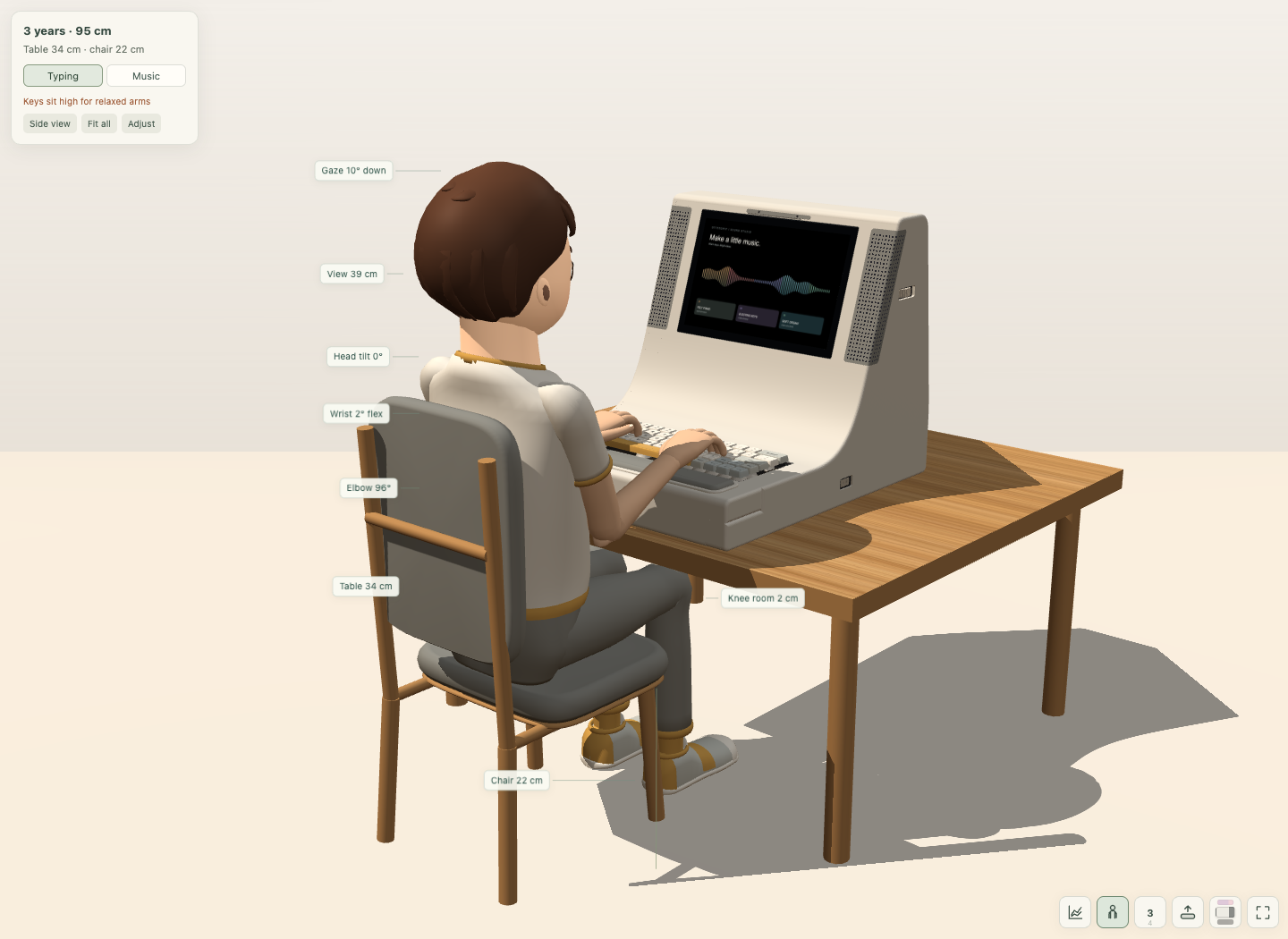
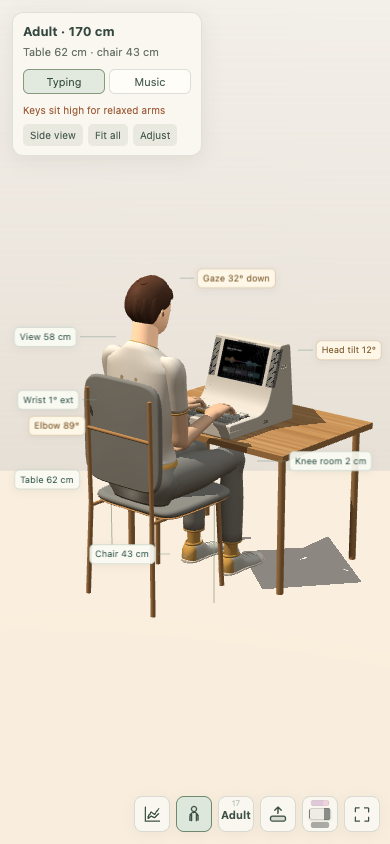
The viewer now leaves 32 px of breathing room around the person and computer on desktop and 22 px on mobile. Callout leaders stop outside their silhouettes. Smooth movement remains, and labels do not paint through the model while easing to another position.
Inspect the evidence.
This is a broader fixed-body search, not proof of an unconstrained global optimum. It retains available donors and the chosen screen. Body proportions, hand contact and the scoring bands are approximations; dynamic playing and individual comfort need direct observation.